
Delaware (Reference only)
Delaware Incorporation Advantages:
The fact that many large, public companies chose Delaware should demonstrate that large, public companies tend to benefit the most from incorporating in Delaware. Also, a major reason for incorporating in Delaware is because many institutional investors require Delaware. However, what about you? If attracting professional institutional capital is not a present or future concern, then this is not a relevant consideration for most entrepreneurs. Similarly, most newly formed corporation owners usually don’t care about how well-developed Delaware corporate law is. Thus, just starting out, Delaware is typically the exception for the corporation. Plus, should a corporation elsewhere grow and then decide that a Delaware corporation would be more favorable and applicable to its situation, it can re-incorporate in Delaware. (We can assist in this.) In the meanwhile, during the corporation’ formidable years, it can use the efficacy of Nevada or Wyoming (our recommendation).
Why Have Companies in the Past Chosen Delaware as their Corporate Home?
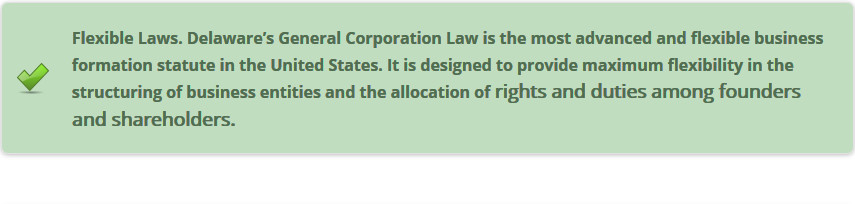
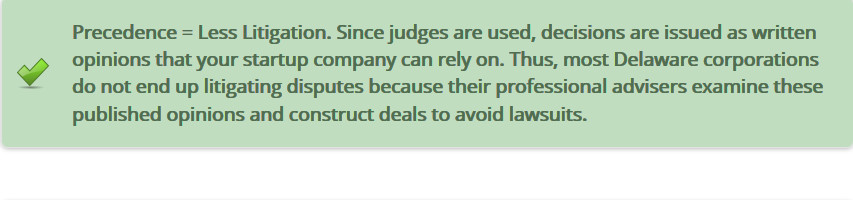
More than half a million business entities have their legal home in Delaware including more than 50% of all U.S. publicly-traded companies and 60% of the Fortune 500 businesses choose Delaware because Delaware provides a complete package of incorporation services, including modem and flexible corporate laws, highly-respected Court of Chancery, a business-friendly State Government, and the customer service oriented Staff of the Delaware Division of Corporations.
Traditional Advantages of Incorporating in Delaware:


Major Disadvantage with Delaware:

Here is what a lawyer which whom we are familiar says about Delaware:
 When forming a new entity, I am often asked the best state of domicile. Following a July 1, 2014 increase in Delaware franchise taxes, I am also often asked the best state to re-domicile or move to following an exit from Delaware. Delaware remains the gold standard; however, there has been a definite shift and Delaware is now not the “only standard.”
Part of the reason for the shift away from Delaware has been the increase in fees. Delaware calculates annual fees based on one of two methods: (i) the authorized share method; and (ii) the assume par value capital (asset value) method. For either method the annual fee is capped at $180,000.00. Even for small- and micro-cap business issuers, the annual fee often reaches the tens of thousands. For example, a company with 300,000,000 common shares authorized with a $.001 par value per share and 30,000,000 shares issued and outstanding and $20,000,000 in gross assets would pay $180,000.00 per year using the authorized share method and $70,350.00 per year using the assumed par value method.
This is a very significant expense for a small company and, as you can see, the assumptions I have made reflect a very small business.”
Forming a Non-Profit – We Can Assist
Caveat: Please note that Non-Profits cannot distribute any profits to their members, contribute money to political campaigns, or engage in political lobbying. For advice, please obtain assistance from a lawyer that specializes in Non-Profits.
What's Involved in Forming a Non-Profit Organization
Forming a non-profit organization is a 3-step process:

Form a Corporate Entity
The first necessary step is the formation of a corporate entity in one of the United States. Although this step closely resembles formation of a regular for-profit corporation, there are specific requirements that must be observed when forming a non-profit entity. State fees may also be different from those for for-profit corporations, usually lower.

Apply for Federal Tax Exemptions
The second step is application for tax-exempt status with the federal government. The most commonly-used federal tax exemption used for non-profit corporations is in Section 501(c)(3) of the Internal Revenue Code, which is why most non-profit organizations are referred to as “501(c)(3)” companies. The application is lengthy and complex; and as we are experienced in completing the Form 1023 and the many other forms and documents required for the completion, we can provide assistance in 501(c)(3) formation.

Apply for State Tax Exemptions
The final step is to obtain tax-exempt status in the State where the company is incorporated. Some states grant this status automatically, based on the non-profit formation documents and the 501(c)(3) status. In other states, a separate application is required.
Formalities of Running a Non-Profit
Even after a non-profit is formed, the company must observe many formalities and make timely filings with the IRS. Non-profit corporations are required to observe all of the same corporate formalities as their for-profit counterparts, including holding regular meetings of the board of directors and recording the minutes of these meetings.
In addition, non-profit corporations are required to keep books and records detailing all activities, both financial and non-financial. Financial information, particularly information on the sources of support (contributions, grants, sponsorships, and other sources of revenue) is crucial to determining an organization’s private foundation status. Any non-profit qualified under Section 501(c)(3) exemption must file an annual information return: Form 990, Form 990-EZ, Form 990-PF or Form N-990. Each State also has it’s own filing requirements for non-profit corporations. We can assist in these preparations and can recommend a CPA for final review of these filings. Finally, all 501(c)(3) non-profits are required to have a Federal Tax ID (EIN) number, regardless of whether they have any employees. We can assist in preparing and filing your non-profit organization application should your requirements dictate.